
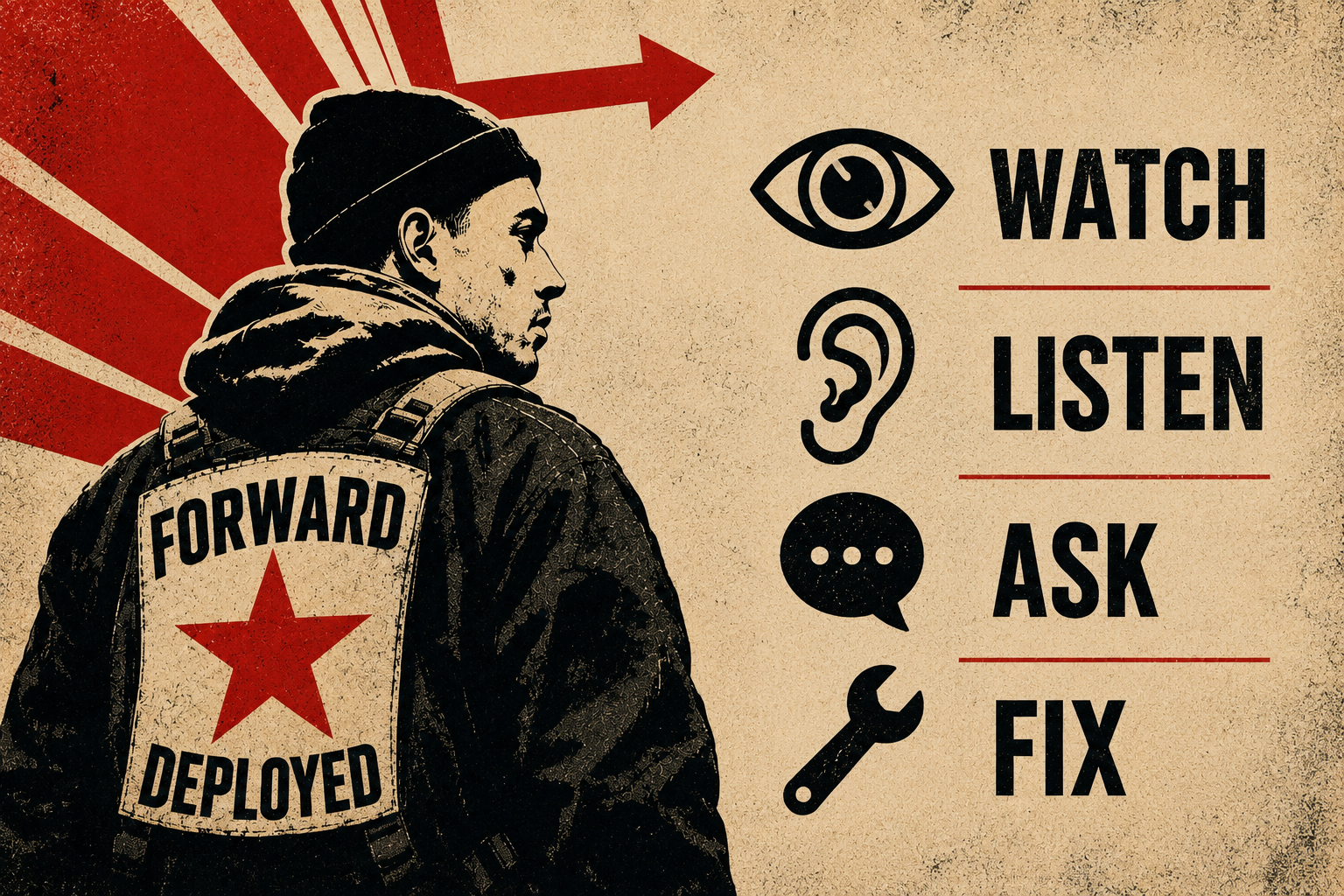
“Forward deployed” started as a term in engineering and consulting. It describes people who work directly with the customer instead of sitting at a distance from the problem. In practice, it means being close enough to see friction as it happens and close enough to fix it quickly. Designers need to be thinking and working this way.
For designers, forward deployment means spending less time discussing users and more time sitting with them. Watching how they work. Hearing the language they use. Seeing where systems break down, where people create workarounds, and where intent gets lost between teams. It sounds obvious, but I still see clients keen to build a solution but reluctant to name actual users who will be using the product.
A lot of product work slows down because information passes through layers. Research becomes a presentation. Feedback becomes a Jira ticket. A customer problem becomes an abstract roadmap item. By the time it reaches the people building the thing, the sharp edges have been rounded off. We are seeing shifts in how the consulting model works – clients have less time for large, bloated mediocre teams who deliver PDF presentations instead of processes and products that deliver change.
Forward deployed teams collapse that distance.
The rise of generative AI prototyping makes this even more powerful. Designers and engineers can now build realistic workflows, interfaces, and interaction patterns in hours instead of weeks. You can walk into a client session with a rough idea in the morning and leave with something testable by the afternoon.
That changes the role of research. By sitting next to the customer in their environment, the feedback loop gets tighter. Instead of spending weeks dreaming up a static concept, teams can put something tangible in front of users almost immediately. The conversation becomes more concrete. Users react to behaviour rather than descriptions. You learn faster when you are in the room rather than talking about the room. Full stop. You can become Emphatically Empathetic by doing the job alongside your user.
The best product decisions often come from moments that never appear in a report. A user hesitating before clicking a button. Someone opening a spreadsheet to work around your tool. A client casually mentioning a process that everyone assumed was impossible to change. Those moments are easy to miss when teams operate at a distance.
Forward deployed teams optimise for proximity. Proximity to users, to decisions, and to outcomes. The result is usually better products, faster iteration, and a much clearer understanding of what actually matters.