
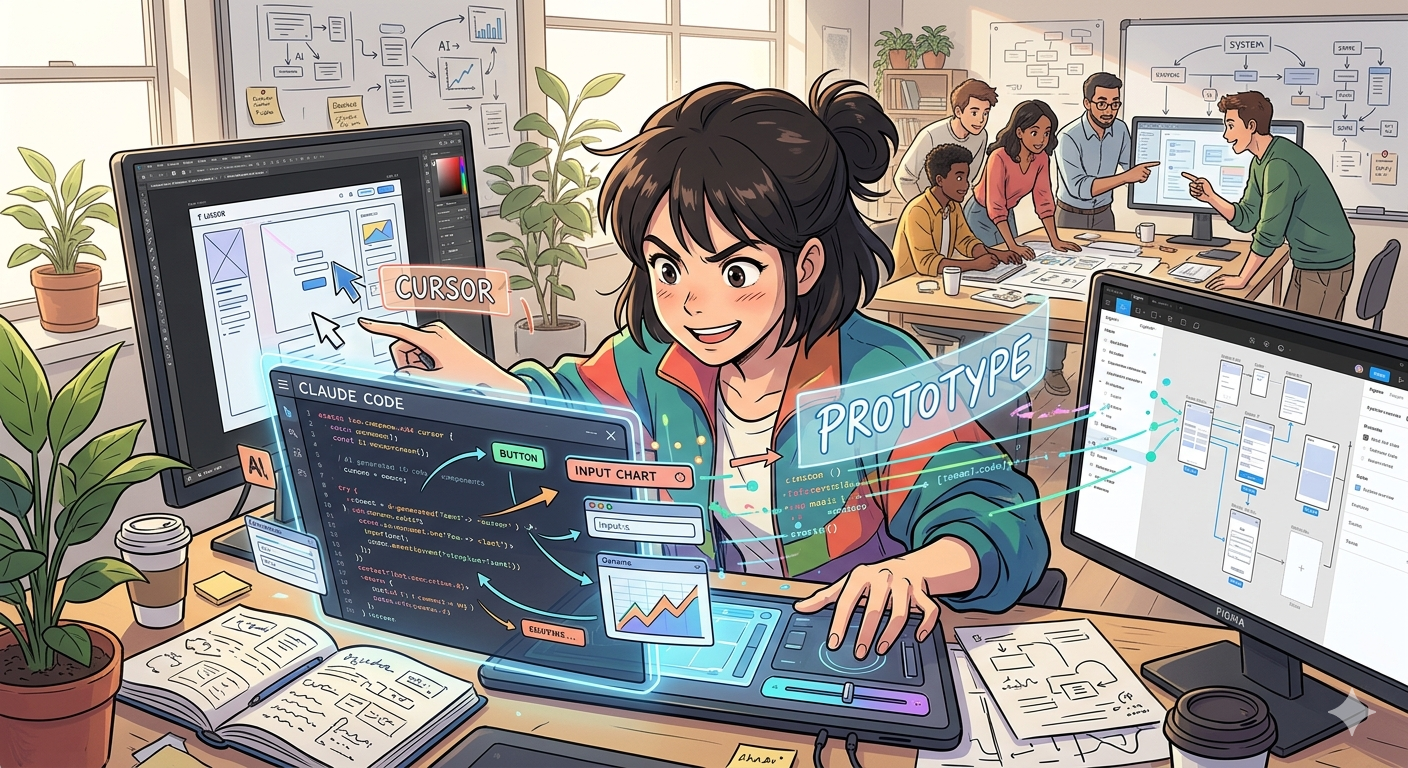
Design tooling has fundamentally changed with the latest and greatest vibe-coding tools. It’s now faster than ever to get high quality, high fidelity prototypes up and running. This is a job advert for a product designer role at Ramp – a design-centric SaaS company in the finance space:
Own product work end to end: Partner with PM and engineering to define problems, explore solution spaces, validate concepts, and ship product improvements that move key metrics. Stay involved through launch and iteration, not just handoff.
Start in an LLM: Use tools like Claude to clarify intent, draft short PRDs, and surface risks, edge cases, and initial approaches. Use this work to align quickly with your team.
Validate assumptions with self-serve research: Talk directly with customers, run quick tests, and use what you learn to adjust direction. Treat research as a velocity tool, not a gate.
Prototype using AI tools: Use Cursor and Claude Code to build and iterate on flows and simple interfaces. Let AI generate code while you guide structure, behavior, and UX quality. Partner with engineers to decide what moves into the product.
Bring work into Figma: Translate validated concepts into Figma for full state coverage, system alignment, and production readiness.
Design for the 80 / 20: Encode judgment and complexity under the hood while keeping the default experience simple and successful for most customers.
Contribute to patterns and culture: Share prompts, patterns, and learnings with the design org. Participate in crits and reviews that raise the bar for quality.
It reflects a way of working I have used while working at Faculty. The need to get to value (both financial and value for users) fast means designers need to be prototyping with generative AI tools like Claude Code and Cursor to understand key layout considerations, flows, and technical possibilities. The speed of this rapid prototyping would not be possible in traditional layout tools like Figma. Other benefits of using code to prototype are the ability to very quickly use realistic data, either generated by AI or getting or directly from a schema in an existing system.
When you prototype in code with LLMs the shift goes from designing static interfaces to designing systems that behave. This is a huge shift in how designers work on products.
- States aren’t enumerated upfront → they emerge
- UX is no longer deterministic → it’s probabilistic
- The interface is partly generated → not fully authored
Designers are increasingly responsible for shaping system behaviour — defining how products respond, adapt, and generate — rather than specifying fixed screens.
There is still a place for Figma in the process – the canvas-based approach to design is invaluable in laying out states, and keeping track of iterations.