

AI systems are increasingly moving beyond summarisation and copilots into something more consequential: decision support.
Across regulated industries, and some national infrastructure, organisations are beginning to deploy systems that recommend actions, draft decisions, prioritise cases, assess eligibility, identify risks, or guide frontline staff through operational processes. These systems promise substantial efficiency gains — often the central driver behind the business case for adoption.
But they also introduce a difficult question:
How do you design decision-making systems that are both fast and accountable?
Because the moment an interface becomes too frictionless, there is a risk that the human reviewer stops exercising meaningful judgement and becomes little more than a rubber stamp.
At the same time, adding excessive friction defeats the purpose of automation entirely.
This tension — between speed and scrutiny — is likely to become one of the defining product, legal, and governance challenges of the agentic AI era.
The Real Problem Isn’t “Human in the Loop”
Many organisations frame safety and accountability around the idea of “keeping a human in the loop”.
But in practice, this is often insufficient.
A human who simply clicks “approve” on a highly polished AI recommendation is not exercising meaningful oversight. They are participating in a workflow designed around automation bias.
The real objective should not be human presence. It should be:
accountable human judgement at the right points in the process.
Good decision-support systems should preserve the uniquely human parts of decision-making:
- interpreting ambiguity;
- weighing competing considerations;
- spotting edge cases;
- exercising discretion;
- and taking responsibility for the outcome.
The challenge is designing interfaces and processes that support this without destroying operational efficiency.
Four Layers of High-Stakes Decision Systems
When thinking about agentic decision interfaces, it is useful to separate the problem into four layers.
| Layer | Core Question |
|---|---|
| Decision Model | What is the system allowed to decide, recommend, draft, or merely surface? |
| Reviewer Experience | How do we prevent rubber-stamping while preserving speed? |
| Assurance & Audit | How do we prove the system behaved appropriately? |
| Legal & Governance | How do we ensure compliance and manage liability? |
These layers are deeply interconnected. UI choices affect legal defensibility. Governance choices affect product usability. Audit design affects operational burden.
Treating them separately often leads to gaps.
Friction Should Be Risk-Based, Not Universal
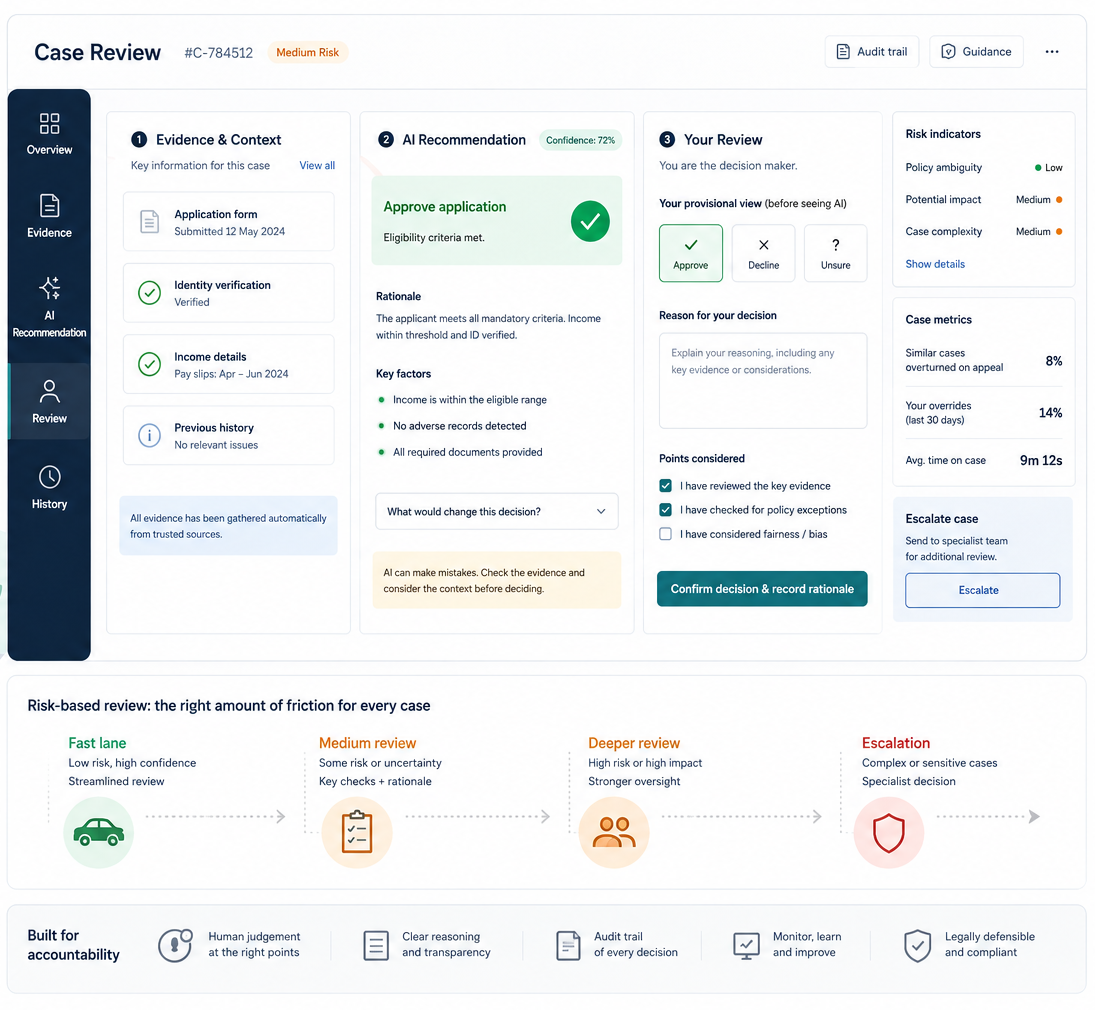
One of the biggest mistakes in designing review workflows is applying the same level of scrutiny to every case.
In reality, some decisions are routine and low-risk, while others involve substantial ambiguity, legal consequences, or impacts on individuals’ rights.
The right approach is usually risk-adjusted oversight.
For example:
| Risk Signal | Possible Interface Response |
|---|---|
| Low model confidence | Require additional review |
| Novel or unusual case | Escalate to specialist reviewer |
| Material adverse impact on an individual | Require explicit rationale |
| Policy ambiguity | Force reviewer to choose interpretation |
| Sensitive characteristics nearby | Trigger fairness checks |
| Prior appeal patterns | Add secondary review |
This allows systems to remain fast where appropriate while concentrating human attention where it matters most.
The goal is not to maximise friction.
It is to maximise meaningful scrutiny per unit of cognitive effort.
Designing Against Automation Bias
Research on automation bias consistently shows that people tend to over-trust system recommendations — particularly when systems appear authoritative, polished, or statistically sophisticated.
This becomes especially dangerous in high-throughput operational environments where reviewers face time pressure and performance targets.
Several interface patterns can help mitigate this.
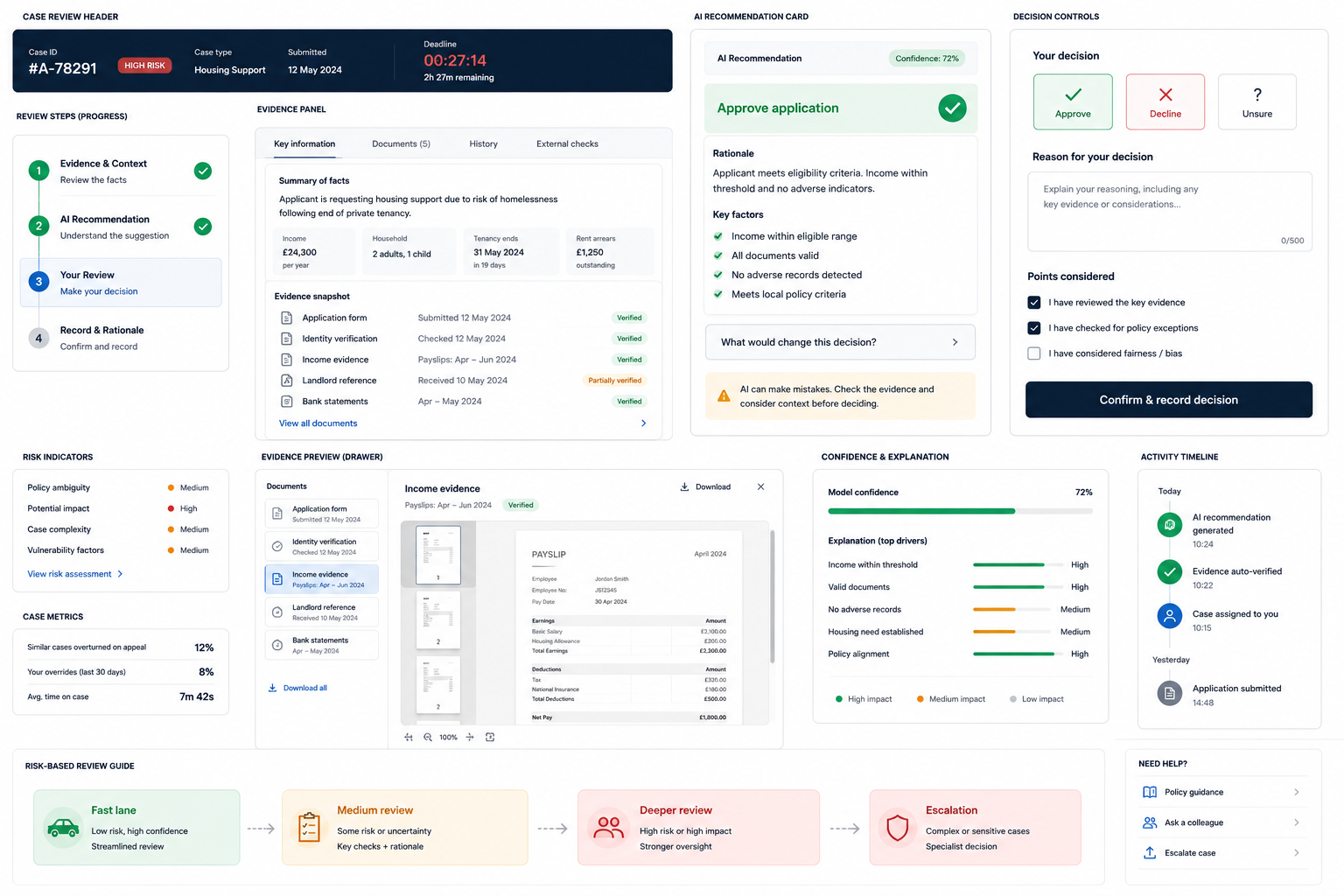
Evidence-First Review
Rather than leading with the AI recommendation, show the underlying evidence and context first.
This encourages independent interpretation before anchoring occurs.
Independent Judgement Before Recommendation
For higher-risk decisions, reviewers can record a provisional assessment before viewing the system recommendation.
This creates cognitive separation between human judgement and machine suggestion.
Make Disagreement Normal
Interfaces should make it frictionless to disagree with the system.
If disagreement requires extra effort, justification, or managerial scrutiny, reviewers will naturally converge toward passive acceptance.
Require Reasoned Confirmation
“Approve” buttons encourage passive interaction.
Instead, reviewers may be asked to confirm:
- what evidence they relied upon;
- why the recommendation is appropriate;
- or what risks they considered.
The key is not adding bureaucracy for its own sake, but preserving active cognitive engagement.
Focus Attention Strategically
The objective is not to force humans to re-check everything manually.
That simply recreates the original workload.
Instead, systems should direct reviewer attention toward:
- weak evidence;
- uncertainty;
- policy ambiguity;
- fairness concerns;
- or anomalous cases.
Good decision-support systems optimise where humans think deeply.
Measuring the Right Things
Many deployments measure success primarily through throughput:
- cases processed;
- time saved;
- approval speed.
But these metrics can mask deteriorating judgement quality.
A reviewer approval rate approaching 100% may not indicate system success. It may indicate that humans have stopped meaningfully reviewing outputs.
Important operational metrics may include:
- override rates;
- disagreement patterns;
- appeal and overturn rates;
- reviewer rationale quality;
- subgroup outcome differences;
- escalation frequency;
- time spent on high-risk cases;
- reviewer drift over time.
The quality of human oversight itself should be treated as a measurable operational variable.
Legal Defensibility Matters
As decision-support systems become embedded in public-sector and regulated workflows, legal scrutiny is likely to increase significantly.
Particular risks include:
- unlawful delegation of authority;
- failure to exercise discretion;
- inadequate explanation of decisions;
- inability to challenge outcomes;
- discrimination or unfair bias;
- poor auditability;
- and failures of transparency.
Many jurisdictions are already moving toward explicit requirements for meaningful human oversight in high-risk AI systems.
The critical issue is often not whether AI was involved, but whether humans retained genuine decision-making responsibility.
This is where interface design becomes legally relevant.
If a system is designed in a way that predictably encourages passive approval, courts or regulators may reasonably question whether meaningful oversight existed at all.
Auditability Is a Product Feature
High-stakes systems should be designed from the outset with audit and challenge in mind.
This includes maintaining records of:
- what evidence was presented;
- what recommendation was generated;
- reviewer actions;
- rationale provided;
- timestamps;
- escalation paths;
- and confidence or uncertainty indicators.
Importantly, auditability should not be treated as a compliance afterthought.
Well-designed audit systems improve:
- operational learning;
- appeals handling;
- incident investigation;
- governance reviews;
- and long-term trust in the system itself.
The Emerging Need for “Decision Interface Standards”
Many organisations already have:
- AI governance principles;
- model evaluation approaches;
- data protection processes;
- or UX standards.
What is often missing is a unified approach specifically for high-stakes decision interfaces.
Over time, it is likely that organisations will need reusable standards covering:
- risk-tiering frameworks;
- approved oversight patterns;
- escalation rules;
- audit requirements;
- fairness monitoring;
- reviewer engagement metrics;
- and governance responsibilities.
This is not merely a legal safeguard.
It is becoming part of the operational infrastructure required to deploy agentic systems responsibly at scale.
The broader challenge here is that agentic systems are changing the nature of work itself.
Historically, software automated tasks.
Now systems increasingly shape decisions.
That means interface design is no longer just about usability or productivity. It is about:
- accountability;
- judgement;
- institutional trust;
- and the distribution of responsibility between humans and machines.
The organisations that navigate this well will not simply build faster workflows.
They will build systems that remain trustworthy under pressure, scrutiny, and challenge.