As organisations adopt AI systems for increasingly complex work, “human-in-the-loop” has become the default answer to concerns about trust, accountability and oversight. The idea sounds sensible: let the AI do the work, but ensure a human reviews the output before anything important happens.
In practice, however, many human-in-the-loop workflows are creating a new problem. They are turning experts into reviewers.
Across industries, we are seeing systems that gather evidence, analyse information, generate recommendations and draft outputs, only for a human to sit at the end of the process and approve or reject what the AI has produced. This is often presented as meaningful oversight. In reality, it can become little more than a compliance mechanism designed to reassure organisations that a human was involved.
The challenge is that reviewing AI output is often not where human expertise creates the most value.
“Over time, people either stop paying attention or start assuming the system is probably correct.”
An experienced caseworker, clinician, lawyer or analyst is valuable because they can identify ambiguity, recognise unusual patterns, weigh competing considerations and exercise judgement in situations where rules alone are insufficient. Yet many current AI workflows ask these same professionals to spend their time checking machine-generated summaries, reports or recommendations. The result is that highly skilled individuals become quality assurance functions for systems that were supposed to reduce workload.
This creates a deeper UX problem than many organisations realise. Human beings are generally poor at sustained vigilance. We struggle to maintain attention when our role is simply to monitor and verify. Over time, people either stop paying attention or start assuming the system is probably correct. Both outcomes undermine the very oversight these workflows were designed to provide.
The issue is not that humans should be removed from decision-making. Quite the opposite. The issue is that many systems are involving humans at the wrong point in the process.
The more useful question is not whether a human should approve one decision or one hundred decisions. It is whether we are asking humans to contribute judgement or merely verification.
Historically, software automated tasks. AI is beginning to automate analysis. As this happens, the scarce resource within organisations is no longer processing capacity. It is human attention.
An AI system can review thousands of documents, analyse hundreds of signals and generate dozens of recommendations. A human cannot. What humans can do is decide where attention should be focused. They can identify concerns, challenge assumptions, explore uncertainty and investigate exceptions. These activities are fundamentally different from reviewing output after the fact.
This suggests a different model for AI-assisted work. Rather than treating the human as the final checkpoint, we should treat them as the source of judgement. The AI can gather information, identify patterns, highlight anomalies and draft conclusions. The human’s role is to direct attention towards what matters, interrogate areas of uncertainty and determine how competing factors should be balanced.
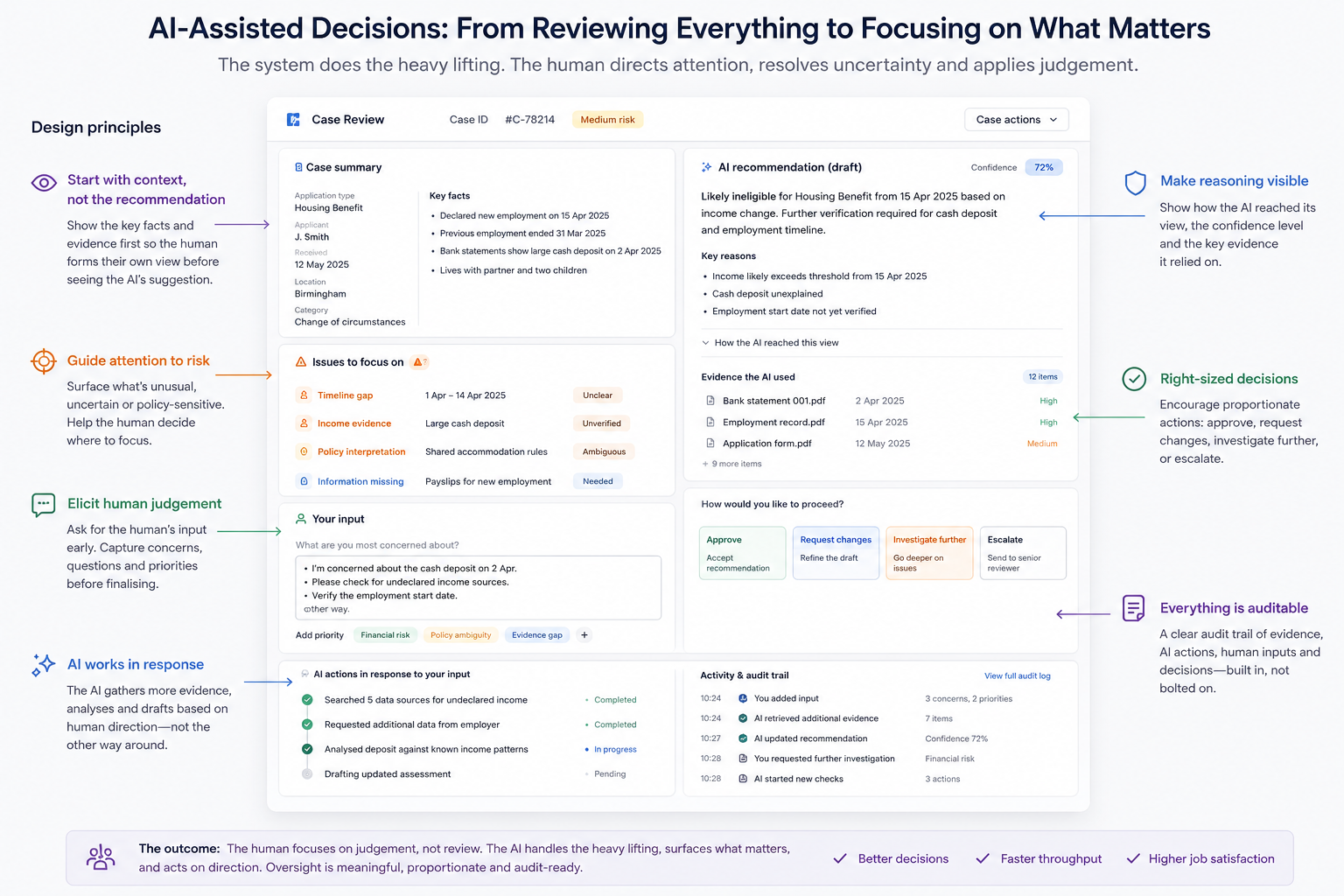
In this model, the system is not asking “Do you approve this?” It is asking “What concerns you?” or “Where should we look next?” The interaction shifts from passive review to active investigation.
This distinction matters because attention is increasingly becoming the limiting factor in high-skill work. Organisations deploying AI systems often focus on reducing effort, but the greater opportunity is improving how expert attention is allocated. The best systems will not require humans to re-check everything manually. They will help humans spend more of their time applying expertise where it matters most.
As AI systems become more capable, the future of human-computer interaction is unlikely to be defined by approval buttons and review queues. Instead, it will be shaped by how effectively we combine machine-scale analysis with human judgement. Human-in-the-loop should not be viewed as a UX pattern in its own right. The goal is not simply to keep a person involved. The goal is to ensure that the finite attention, expertise and judgement of human decision-makers are applied where they create the greatest value.
The organisations that understand this distinction will not just build more efficient systems. They will build systems that make better use of the people who rely on them.